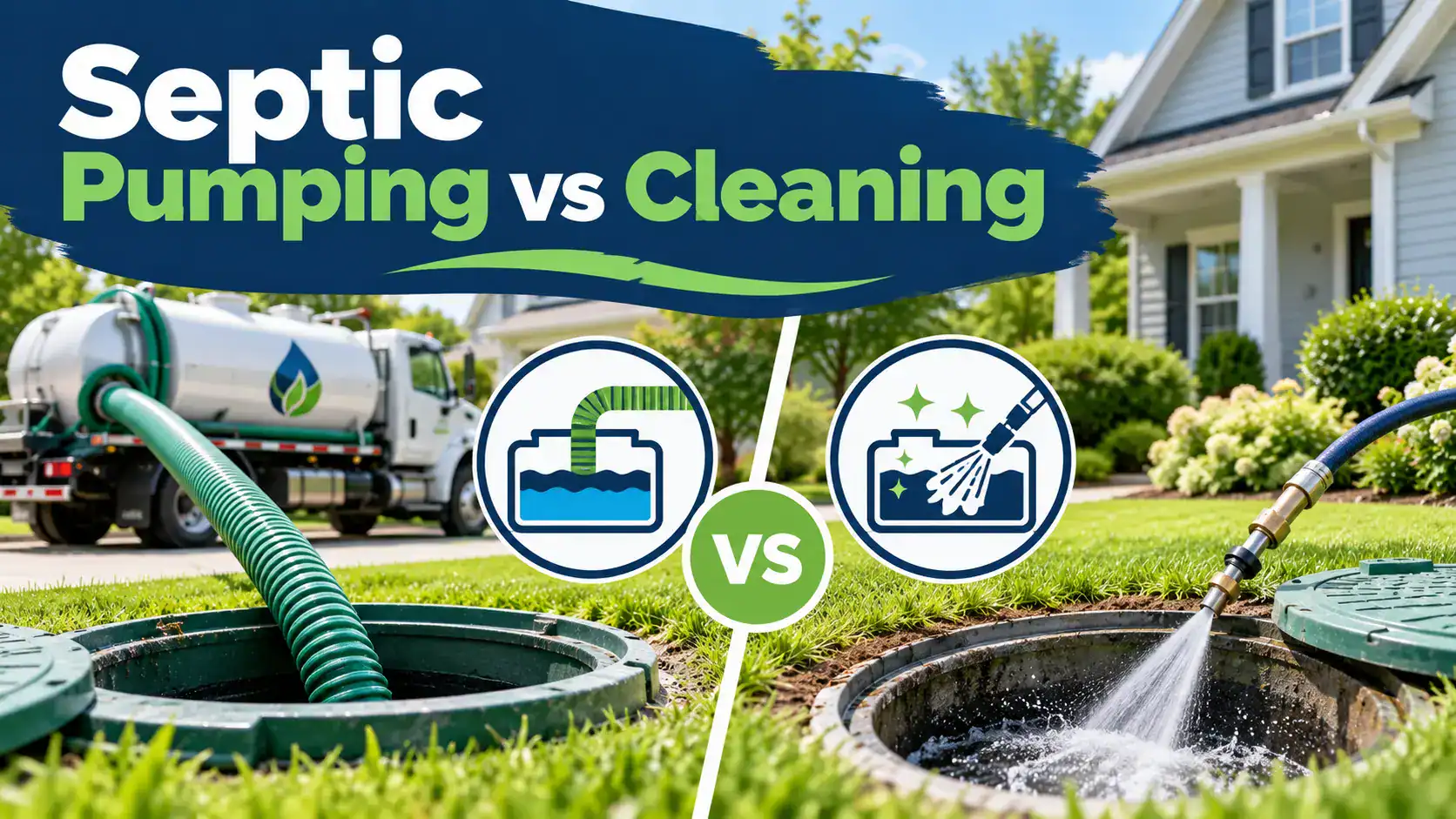

Septic tank pumping removes the sludge and scum that build up inside the tank so solids do not travel into the drainfield. A service truck empties the tank through the main access lid, the contractor loosens the settled solids, and the tank is inspected before it is closed. This guide explains how a septic system holds waste and what a professional pump-out involves from start to finish.
At a glance
- A conventional system has a septic tank and a drainfield (also called a leach field).
- Solids settle as sludge, grease floats as scum, and the liquid in between, called effluent, flows to the drainfield.
- Pumping empties the tank through the large central manhole, not only the small inspection ports.
- A good pump-out includes a check of the baffles and the tank itself.
How a septic system holds waste
According to the EPA, a conventional septic system has two main parts: a buried septic tank and a drainfield. Wastewater from the house flows into the tank. Heavy solids settle to the bottom, and grease and lighter solids float to the top. The liquid in the middle, called effluent, leaves the tank and flows to the drainfield, where it filters through stone and the soil below it and is treated by microbes.
Oregon State University Extension adds more detail in its septic tank maintenance guide. A tank is designed to keep wastewater for a minimum of 24 hours so solids can settle. Tanks have compartments and baffles that direct the flow. About half of the solids break down naturally. The rest builds up as sludge, and that is what pumping removes.
What is in the tank
- Sludge is the layer of settled solids at the bottom of the tank.
- Scum is the layer of grease, oils, and lighter solids that floats on top.
- Effluent is the clarified liquid between the two layers. It flows out toward the drainfield.
- Baffles are the tank fittings that keep sludge and scum from leaving with the effluent.
What happens during a pump-out
Pump-out guidance hosted by the EPA describes the steps a contractor should follow:
- Check the liquid level. Before pumping, the contractor notes where the liquid sits in relation to the tank’s outlet pipe. An unusual level can point to a leak or a drainfield problem.
- Pump through the manhole. The tank should be pumped through the large central manhole, not only through the inspection ports. If a contractor pumps from inspection ports, both should be used so every area of the tank is emptied.
- Loosen the sludge. Oregon State University Extension describes alternately siphoning liquid out and reinjecting it into the bottom of the tank. That stirs up the settled sludge and scum so they can be removed.
- Watch for backflow. If liquid flows back into the tank from the drainfield side while pumping, it suggests a drainfield problem.
- Do not leave septage behind to “seed” the tank. The guidance says additives and seeding do not improve system function.
- Inspect the tank. The contractor looks for an open weep hole, a leaking midseam, damaged baffles, or cracks.
Oregon State University Extension says the baffles should be checked before the tank is closed, and that damaged baffles should be replaced with sanitary tees.
Where the waste goes
The material removed from the tank is called septage. It is hauled away by the pumping company for disposal. Ask any company you are comparing whether hauling and disposal are included in its estimate. Our septic tank pumping cost guide covers what else can change an estimate.
How to prepare for the visit
- Know where the tank is. The University of Maryland Extension says the county health department keeps records of permitted systems in many places and can give location information on request.
- Make the lid reachable. Alabama Public Health says watertight risers and secure lids brought up to ground level keep the tank accessible for inspections and pumpings, and may reduce pumping fees.
- Gather your records. Have the date of your last pump-out, the tank size, and any notes about the filter or baffles ready for the technician.
- Stay away from the open tank. Never enter a septic tank. Oregon State University Extension says it produces toxic gases that can kill within minutes.
After the pump-out
Keep a record of the visit: the date, the company, and anything the contractor found. The University of Maryland Extension says an effluent filter, if your tank has one, should be cleaned or replaced annually by a professional, and Alabama Public Health advises installing a filter the next time the tank is pumped. Ask the contractor whether your tank has one. Learn when you will need the next visit in our guide to how often to pump a septic tank.
Rules vary by state
Permits, licensing, and reporting requirements for septic pumpers differ by state and county. Alabama, for example, requires pumpers to be licensed by its Onsite Wastewater Board. Check your state page on this site and ask your local health department what applies where you live.
Questions to ask about the pump-out
- Will the tank be pumped fully, including the sludge and scum layers?
- Will you look at the baffles and access points?
- Does the tank have a riser or an effluent filter, and does either need attention?
- Where will the waste be taken for disposal?
- Does the company meet the licensing rules in my state or county?
- Will I get a written report, and when should the next inspection be?
Can I use water while the tank is being pumped?
Follow the technician’s instructions. In general it makes sense to hold laundry, dishwasher loads, and long showers during the visit, so new wastewater does not enter the tank while it is being inspected and emptied. Ask when you book, because practices differ from company to company.
Keep a record of the visit
Save the service date, the company, the tank size if known, what the technician saw in the sludge and scum layers, the condition of the baffles, any repairs noted, and the suggested date for the next inspection. Store the report with your permits and system drawings. For what the visit may cost, see our septic tank pumping cost guide.
Find a septic pumping company near you
Browse listed companies by state, county, and city. Check ratings and hours, then call and ask what a visit includes. If you are not sure whether you need pumping or something more thorough, read septic pumping vs cleaning.